

When Is Rehab Necessary for Alcohol or Drug Use?
A Clear, Honest Guide to Knowing When It’s Time to Get Help
In This Article
For many people, the question is not whether alcohol or drug use has become a concern. It is how serious it really is.
▪ You might still be working. ▪ Maintaining relationships. ▪ Managing responsibilities.
But at some point, a deeper question starts to surface:
“Do I actually need rehab, or can I quit on my own?”
The answer depends on several key factors, including your physical dependence, past attempts to quit, and how substance use is affecting your life.
This guide will help you understand when rehab is necessary, the risks, and how to choose the right level of care.
📞 Questions? For Confidential Consultations, Call 408-297-1182 or Contact Us today.

The Short Answer: When Is Rehab Necessary?
Rehab becomes necessary when substance use is no longer something you can reliably control on your own and when the consequences are starting to compound. It is not defined by how “bad” things look on the outside. It is defined by patterns, progression, and loss of control.
Rehab is typically necessary when:
- ▪ You have tried to quit before, but could not stay stopped
- ▪ You experience withdrawal symptoms when not using
- ▪ Your use is increasing over time
- ▪ Substance use is affecting your health, work, or relationships
- ▪ You feel a loss of control over your behavior
- ▪ You are using to cope with stress, anxiety, or emotional pain.
According to the National Institute on Drug Abuse, Understanding Drug Use and Addiction Drug Facts: addiction is a chronic brain disorder, not simply a matter of willpower. This means many people require structured treatment to recover successfully.

Can You Quit on Your Own? (Sometimes, But Not Always)
Some individuals with mild substance use patterns can reduce or stop without formal treatment.
However, research from the National Institute on Alcohol Abuse and Alcoholism (Understanding Alcohol Use Disorder) shows that:
▪ The majority of people with moderate to severe alcohol use disorder struggle to quit without support
▪ Relapse rates are significantly higher without structured care
When quitting alone might work:
▪ No physical dependence
▪ No withdrawal symptoms
▪ Strong support system
▪ Short duration of use
When it usually doesn’t:
▪ Repeated failed attempts
▪ Daily or heavy use
▪ Emotional reliance on substances
▪ Co-occurring mental health issues

Key Warning Signs That Rehab May Be Necessary
1. You’ve Tried to Quit Before (and Relapsed)
Relapse is one of the strongest indicators that additional support is needed.
Addiction changes brain pathways related to reward, stress, and decision-making, making it extremely difficult to stop without intervention.
2. You Experience Withdrawal Symptoms
Withdrawal can include:
▪ Anxiety or irritability ▪ Nausea or sweating ▪ Insomnia ▪ Tremors
▪ In severe cases: seizures or hallucinations
According to the Centers for Disease Control and Prevention (Alcohol Use and Your Health) alcohol withdrawal can be medically dangerous, especially for long-term or heavy users.
👉 This is where supervised detox becomes critical.
3. Your Use Is Escalating
If you’ve noticed:
▪ Drinking or using more than you used to
▪ Needing more to feel the same effect (tolerance)
▪ Using earlier in the day
These are signs of progressive dependence.
4. It’s Affecting Your Life (Even Subtly)
You don’t have to “lose everything” for it to matter.
Early signs include:
▪ Decreased motivation
▪ Strained relationships
▪ Lower productivity
▪ Increased stress or anxiety
5. You’re Using to Cope
Using substances to manage:
▪ Stress
▪ Trauma
▪ Anxiety or depression
… is one of the strongest predictors of long-term dependency.
Confidential Consultations are just a phone call away.
Call 408-297-1182
If you or a loved one is looking for life-changing addiction recovery treatment, New Life Recovery Centers in San Jose provides a proven path to addiction recovery and healing.
Free insurance verification – we accept most insurance.


Why “Quitting on Your Own” Often Fails
Many people believe they should be able to stop through discipline alone.
But addiction is not just behavioral: it’s neurological.
Research published in journals like The New England Journal of Medicine shows that substance use disorders affect:
▪ Dopamine reward systems
▪ Stress response pathways
▪ Impulse control
This is why treatment programs focus on:
▪ Behavioral therapy
▪ Structure and accountability
▪ Long-term coping strategies
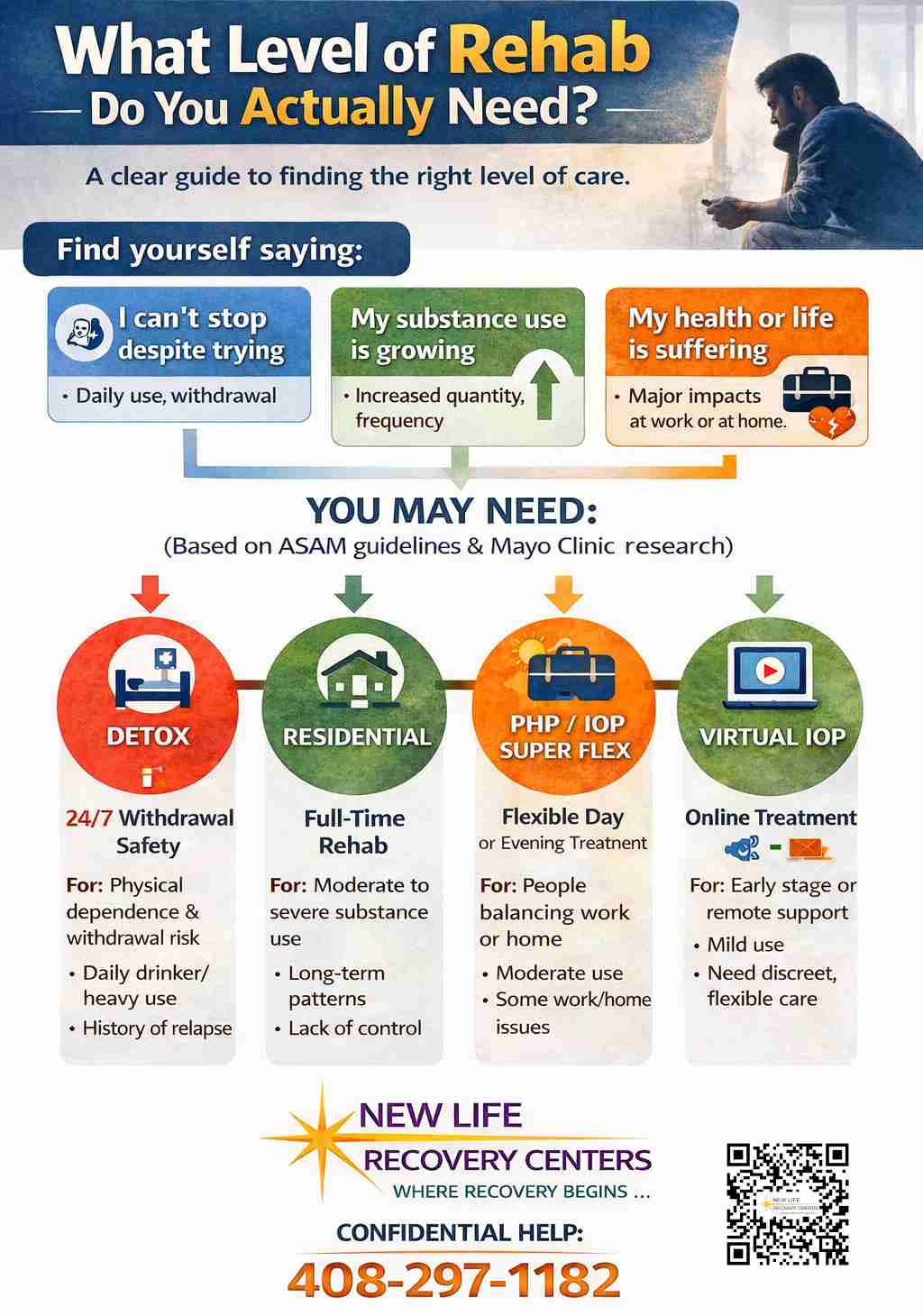
What Level of Rehab Do You Actually Need?
Not everyone needs the same level of care. The right approach depends on severity, history, and personal circumstances.
- Detox (Supervised Withdrawal Support)
▪ For individuals with physical dependence
▪ Helps manage withdrawal safely - Residential (Inpatient) Rehab
▪ Full-time, structured environment
▪ Ideal for severe or long-term addiction - Partial Hospitalization Program (PHP)
▪ Intensive daytime treatment
▪ Allows more independence than inpatient - Intensive Outpatient (IOP Flex)
▪ Flexible scheduling (morning, evening)
▪ Ideal for those balancing work or family - Virtual IOP (Telehealth Treatment)
▪ Discreet, accessible care from home
▪ Especially useful across rural California
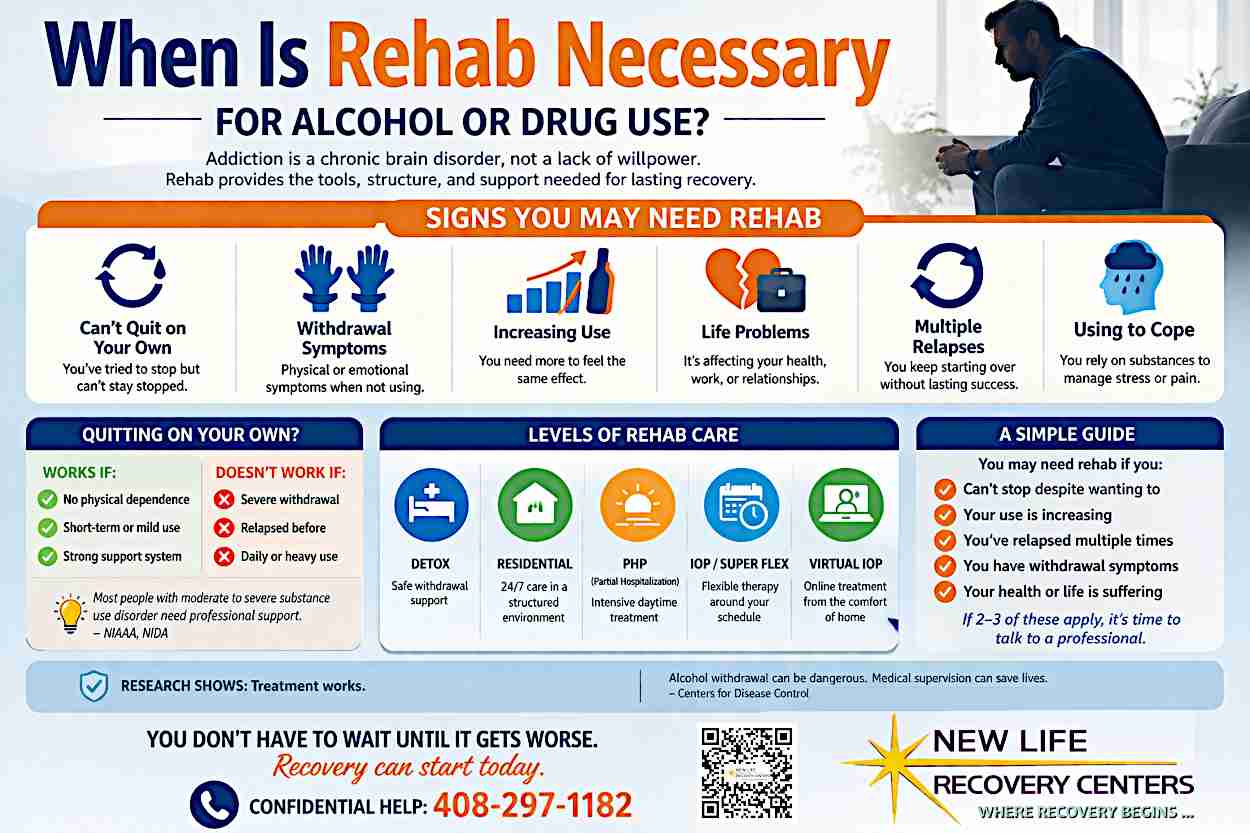
A Simple Decision Framework
You may need rehab if:
- ▪ You can’t stop despite wanting to use
- ▪ Your use is increasing or becoming routine
- ▪ You’ve relapsed multiple times
- ▪ You experience withdrawal symptoms
- ▪ Your mental or physical health is being affected
If even 2–3 of these apply, it’s worth speaking with a professional.
Confidential Consultations are just a phone call away.
Call 408-297-1182
If you or a loved one is looking for life-changing addiction recovery treatment, New Life Recovery Centers in San Jose provides a proven path to addiction recovery and healing.
Free insurance verification – we accept most insurance.
Taking the Next Step
If you’re asking whether rehab is necessary, that question itself matters.
It means:
You’re aware
You’re evaluating
You’re open to change
And that’s where recovery begins.

Talk to Someone Who Understands
At New Life Recovery Centers in San Jose, individuals receive support across every stage of recovery. This includes detox through residential care, outpatient care, and Virtual IOP Telehealth treatment options throughout Northern California.
Whether you need full-time care or flexible support, there is a path forward that fits your life.
Final Thought
You don’t need to have all the answers.
But if the question keeps coming up…
“Do I need rehab?”
…it may be time to take that next step.

Your New Life Starts Here
No matter where you are in your journey, New Life Recovery Centers, San Jose, is ready to walk beside you. With over two decades of experience and a commitment to personalized care, we provide a healing environment rooted in compassion, dignity, and proven clinical practices.
We believe recovery is possible at any stage. And that with the right tools, support, and treatment, each person can grow into the best version of themselves.
📞 Ready to take the first step? Call 408-297-1182 or Contact Us today.

Podcast: When Is Rehab Necessary for Alcohol or Drug Use?

Click to listen here or on YouTube – 18 minutes